
Criteria & Principles
Dalbavancin is formulary, stocked
Restricted to Infectious Diseases Consult & ASET.
Inpatient Use: ID consultants to page (970-6666) or secure chat (ASET Med group) for approval. Approvals will occur M-F 8-5pm.
If considering 2 dose strategy where the second dose is given in the outpatient setting, the second dose must be evaluated for financial feasibility after ASET approval and BEFORE arranging inpatient administration. To evaluate financial feasibility:
- ID team to place recommendations for dalbavancin regimen & dosing in consult note, place an OPAT treatment plan for dalbavancin, and alert primary team (more information about OPAT processes click here)
- Primary team to evaluate financial feasibility of ambulatory dose – see attached tipsheet for recommended infusion locations based on insurance. Case management can assist with home infusion investigation.
- If outpatient dose is financially feasible for the patient:
- Primary team will enter order for inpatient dose and work with case management to coordinate outpatient home infusion dose.
- If outpatient dose will be given at Duke Clinic 2A, a THERAPY plan will need to be placed by ID consult team (example instructions can be found in attachments of this page) and primary team will need to coordinate scheduling with the infusion clinic.
- If outpatient dose is not financially feasible:
- Primary team should notify ID to assist with alternative antibiotic recommendations.
- ID consultant to update note and OPAT treatment plan (or delete altogether) with new regimen
Note: ID/ASET approval must be completed BEFORE presenting the option of dalbavancin to the patient(s)/caregiver(s) or documented in a progress note
Outpatient Use (only): ID provider to enter treatment plan note for AIM to initiate financial approval. Ambulatory administration can be scheduled with home infusion or in a Duke infusion clinic. Secure chat AIM pharmacist with questions.
Adjustment of Dose & Administration
Indication-Specific Adjustment
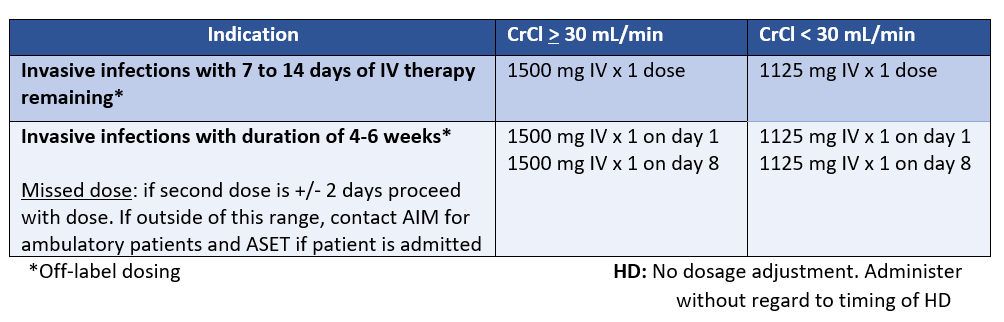
Additional Dosing Details
Single dose (1500mg)
- Uncomplicated S aureus bacteremia with < 14 days of IV therapy remaining
- Complicated S aureus bacteremia with source control and < 14 days of IV therapy remaining
- Skin and soft tissue infection where PO options are contraindicated
Two dose (1500mg on D1 and D8)
- Complicated S aureus bacteremia
- Vertebral osteomyelitis
- Sternal wound infections
NOTE: Single dose inpatient and 2nd dose ambulatory (preferred)
Indications to avoid
- CNS infection or epidural abscess
- Infections when source control cannot be obtained (e.g. undrained abscess)
- Polymicrobial infections
Restricted Use
Restricted to Infectious Diseases Consult & ASET
Cost Index
$$$
General Notes
- Up-to-date cost information, click here
- IV antimicrobials outpatient (OPAT) dosing, click here
- Obesity dosing weight recommendations here
- Helpful drug-drug interaction check website here
- When dosing guidance is provided it is important to note the following:
Fixed (ie non weight-based) doses in adults are historically based on a 70 kg patient. Specific disease states or individual patients may warrant dosages that differ from the above recommendations. Since product-specific criteria for dose adjustment based on creatinine clearance exist, consult product information regarding specific recommendations for dosage adjustment based on estimated creatinine clearance.